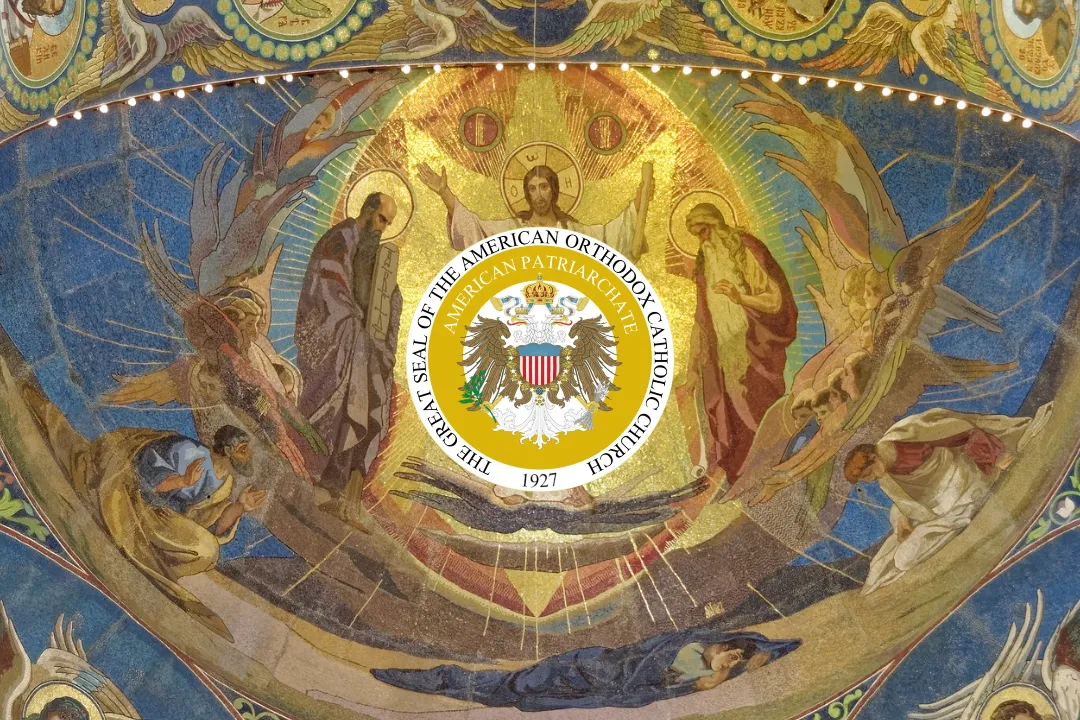
A Crisis In Orthodoxy
AOCC Response To Widening Orthodox Crisis
One of the unfortunate casualties of the Russian war in Ukraine has been its impact on the broader Orthodox Church. Over the last few years, much has been said within Orthodoxy that is deeply troubling, and now pressures both inside and outside the Church threaten the unity of the Orthodox world more broadly.
A great deal has been said regarding Ecumenical Patriarch Bartholomew’s position on the canonicity of the Ukrainian Orthodox Church. This has contributed to a widening rift between Constantinople and Moscow and has affected Orthodox communities internationally, including those here in the United States.
It may not be long before both sides formally declare schism against one another.
Which brings us to the most pressing issue in this present moment.
Last week, Congressman Joe Wilson (R-SC) inserted himself into the ongoing controversy. He stated, “The Russian Orthodox Church is not a separate religious organization but an extension of the Russian state. Evangelizing is illegal in Russia and Christians are targeted and killed in Ukraine. Members should not entertain this intelligence operation.”
Unsurprisingly, this drew swift responses from the Russian Orthodox Church, ROCOR, and the Orthodox Church in America (OCA). Delegations of bishops and priests scheduled meetings with members of Congress and with the Trump administration.
On Thursday, November 20, 2025, the Archons of the Ecumenical Patriarchate issued a forceful statement siding with Rep. Wilson and thanking him for his remarks. They went even further, asserting that “a splinter group calling itself the Ukrainian Orthodox Church remained aligned with the Moscow Patriarchate. That splinter group… is now targeting and killing members of the canonical Orthodox Church in Ukraine, targeting civilians in order to sow terror among the population and make them too frightened to join the canonical Orthodox Church of Ukraine.”
The Archons urged the Trump administration to cancel its meeting with the Russian-affiliated delegations and labeled all involved “Russian state agents.”
Shortly thereafter, Fr. Thomas Soroka called upon the Holy Synod of the OCA to suspend or withdraw its membership in the Assembly of Canonical Orthodox Bishops (ACOB) in response to the Archons’ statement. “I am absolutely appalled at the statement of these ‘rulers,’” wrote Soroka, an influential priest within the OCA.
So what is really happening here?
Is this merely a matter of politics and war, or is something deeper taking place?
It is true there is resentment that Constantinople appears to be aligning itself with American political rhetoric and implying that the Russian Orthodox Church, ROCOR, and the OCA are functioning as propagandists for the Russian state.
But this is only the symptom—not the root.
On November 17, Metropolitan Anthony of Boryspil and Brovary, Chancellor of the canonical Ukrainian Orthodox Church, warned believers against proposals to join a “temporary exarchate” under Constantinople as an alternative to uniting with the schismatic Orthodox Church of Ukraine.
He emphasized that the core issue is not politics, language, or cultural identity, but canonical validity—specifically, the presence of Apostolic Succession and the activity of the Holy Spirit. He argued that both are lacking in any Constantinople-linked structure being proposed in Ukraine.
At the heart of the matter lies the age-old question of jurisdiction as it pertains to canonicity. In short, the modern understanding of canonicity isn't always about Orthodoxy. Sometimes it's about politics, power, and money. True canonicity is about maintaining the faith and practice of the apostles handed down to us.
This is the very issue plaguing Orthodoxy in America today.
Who is the American Patriarch?
If this question were resolved, the ethnic and political tensions currently tied to “Russian” identity would largely fade away within the United States.
So, has this crisis been created by the jurisdictional canonicity problem?
While it is true that the American Orthodox Catholic Church (AOCC) was established as an autocephalous Church by the Russian Orthodox Church in 1927—making it the first and only explicitly Canonical American Orthodox jurisdiction—it is also true that after Russia fell to communism, the AOCC was abandoned by Russia and left to defend itself against outside jurisdictions fighting against the AOCC for the establishment of their own jurisdictions. So the AOCC has NO external ethnic orthodox ties.
Over the past century, as immigration to the United States increased, the various ethnic Orthodox communities did not assimilate into the AOCC during its formative years. Instead, they violated the canons by establishing their own overlapping jurisdictions, violating the very canons they claim to uphold.
This profoundly shaped the AOCC’s future and continues to affect and challenge our canonical standing to this day.
Looking ahead, the question becomes: What will happen as the Orthodox world divides between Russia and Constantinople?
What will become of Orthodoxy in America when these two major centers formally label each other schismatic?
Will the damage to the unity of the Church be irreparable in the near future?
This is the tragic inheritance of overlapping jurisdictions. A foundational canon—Canon 28 of the Fourth Ecumenical Council at Chalcedon—defined the jurisdictional boundaries of the Ecumenical Patriarchate and stated clearly that each bishop and local church has a defined territory. No bishop or Church is to interfere in the territory of another.
The repeated violations of this principle have led to many of the challenges faced by the AOCC and Orthodoxy in America more broadly. While the history is complex and multifaceted, jurisdictional overlap remains at the root of our troubles.
What ethnic Orthodox groups are doing in Ukraine today is, in many ways, what they have already done in America since the 1920s. But the AOCC is ready and willing to be the Church America needs in this season.
Let us join together in prayer for the Orthodox Church—for unity, healing, and restoration in our Lord Jesus Christ.
Together, we are the Bride of Christ.
In the name of the Father, and of the Son, and of the Holy Spirit. One God.
Amen.

