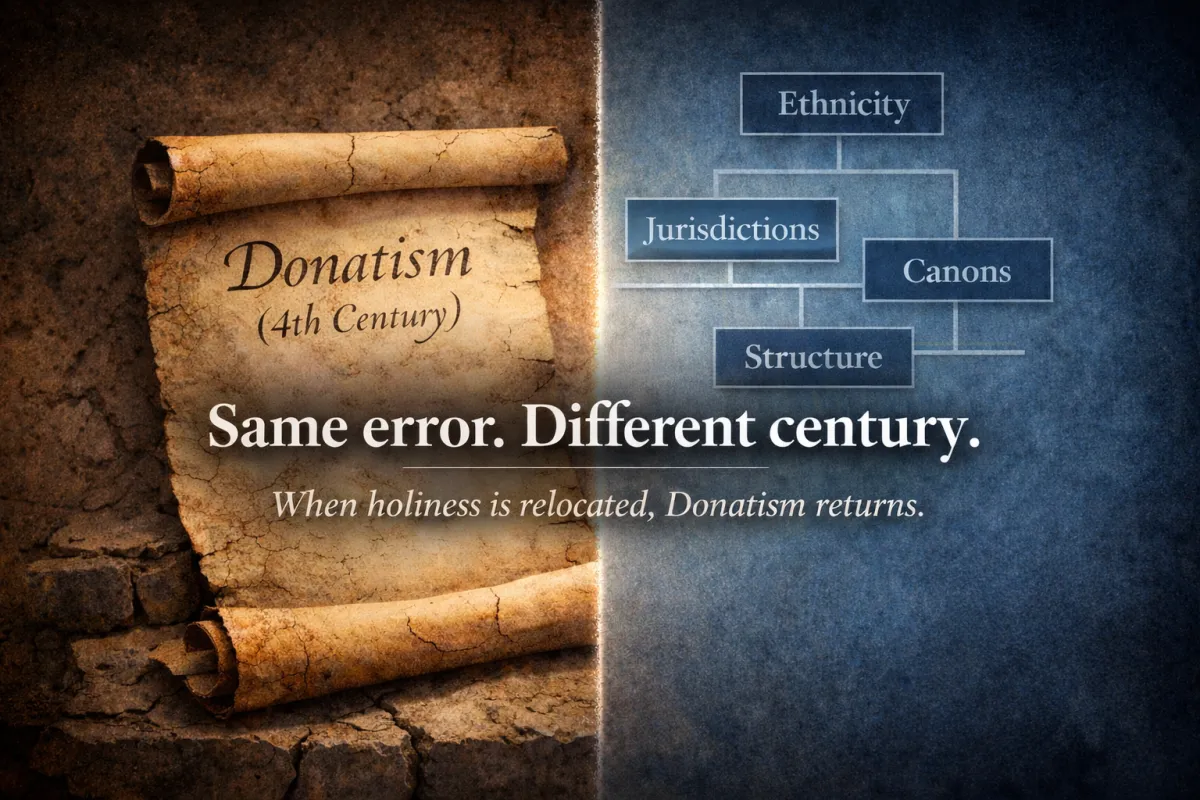
A Reflection on Donatism, Ethnophyletism, and the Canonical Crisis in the American Church
One of the most persistent dangers facing the Church is not overt heresy, but a slow displacement of first principles, when what belongs properly to Christ is transferred, often unintentionally, to human structures, identities, or mechanisms meant to protect Him. Donatism, though long condemned, survives precisely in these quiet substitutions.
Historically, Donatism claimed that the validity of the Church’s sacramental life depended on the moral purity of her ministers. If the bishop or priest fell, grace itself was thought to be compromised. The Church rejected this not because sin was insignificant, but because grace does not originate in the servant. Grace belongs to Christ. The minister is an instrument, not the source.
Yet Donatism never truly disappears. It mutates. In every age, it reappears wherever Christians begin to believe, explicitly or implicitly, that the Church’s holiness depends on the right kind of people rather than on the abiding faithfulness of Christ.
In the modern Orthodox world, this logic has expanded beyond individual moral failure into questions of identity, culture, and structure, with ethnophyletism and the canonical crisis in the United States acting as accelerants rather than correctives.
Ethnophyletism, condemned by the Church in the nineteenth century, was not rejected merely because it confused nationality with ecclesial life. It was condemned because it redefined the source of catholicity. The Church was no longer catholic because Christ fills all things, but because a particular people, culture, or historical memory was thought to preserve Orthodoxy more purely than others.
Once this assumption takes hold, grace becomes culturally localized, tradition becomes ethnically curated, and communion becomes conditional. The Church ceases to be the place where all are healed in Christ and becomes a collection of guarded inheritances.
Where classical Donatism said, “This priest is unworthy; therefore grace is endangered,” ethnophyletism says, “This people or jurisdiction is compromised; therefore Orthodoxy there is suspect.”
The structure of the error is the same. Only the object has changed.
Into this already fragile ecclesial environment entered the canonical movement in the United States, which, while motivated by a legitimate desire for order, unity, and ecclesial normalcy, has often unintentionally reinforced the very distortions it seeks to heal.
Canonically speaking, the situation of overlapping ethnic jurisdictions in one territory is irregular. The ancient canons presume one bishop in one city, not multiple parallel hierarchies divided by ethnicity. By this measure, the continued refusal of ethnic Churches to recognize or work toward an American patriarchate, or even a truly unified local Church, represents a real canonical violation, sustained largely by ethnic loyalty, political memory, and fear of loss.
Yet the canonical movement, in reacting to this disorder, has often introduced a new form of Donatist logic, which may be called structural Donatism.
In this form, ecclesial legitimacy becomes dependent not on Christ’s presence, but on canonical alignment itself. The question subtly shifts from “Is Christ present and active here?” to “Is this structure correct, recognized, and uncontested?” Grace begins to feel safer only within the “right” jurisdiction, under the “right” ecclesial configuration.
Thus, while ethnic jurisdictions may implicitly claim legitimacy through ancestry, the canonical movement may implicitly claim legitimacy through form. One absolutizes identity. The other absolutizes structure. Both risk relocating holiness.
The tragedy is that these two errors now feed one another.
Ethnic churches resist unification by appealing to history and culture. Canonical purists respond by treating canonical irregularity as near ecclesial nullity. The faithful are caught in between, often experiencing sacramental anxiety, ecclesial suspicion, and a quiet erosion of trust.
In practice, this produces a distinctly modern Donatism. Grace is no longer questioned because a priest sinned, but because a jurisdiction is considered irregular. Communion is not denied outright, but internally problematized. Unity is postponed indefinitely in the name of protecting purity.
What is lost in this struggle is the Church’s lived self understanding. She is holy even when disordered, one even when fractured, and catholic even when culturally plural, because her unity does not originate in ethnicity, morality, or canonical perfection, but in Christ Himself.
The Orthodox Church has never denied the importance of canonical order, nor has she denied the danger of ethnophyletism. What she has always denied is the claim, spoken or unspoken, that human disorder has the power to nullify divine fidelity.
When we begin to believe that Christ is fully present only where identity is preserved or canons are perfectly enacted, we have not solved Donatism. We have refined it.
The Church remains holy not because her structures are flawless, her cultures pure, or her jurisdictions settled, but because Christ remains faithful to His Body, even when His servants struggle to be faithful to one another.
The solution is not the abandonment of canon law, nor the romanticizing of ethnic memory, nor the absolutizing of structural reform. It is repentance, both personal and collective. It is humility before the mystery of the Church. It is refusing to turn either culture or canons into substitutes for Christ.
Whenever Christ is no longer enough to guarantee the Church’s holiness, something else will quietly take His place.
And that replacement, whether moral, ethnic, or canonical, is the true danger.

